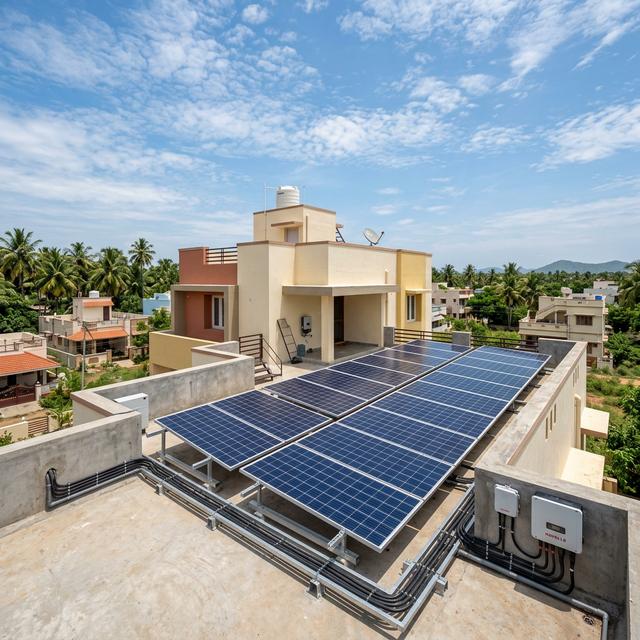
Residential solar allows homeowners to generate electricity from sunlight and use it to power everyday household needs. Whether you own an independent house, villa, or are planning a community solar solution, Future Volt helps you explore the right system for your property.
Our approach combines energy assessment, system design, installation planning, and ongoing support to help you move towards cleaner and more dependable energy.
Understand how solar power flows through your home, battery and electricity grid.
Generate clean solar electricity while staying connected to the electricity grid.
Compare on-grid, off-grid, and hybrid solar systems to understand their components, costs, backup capabilities, and suitability for commercial applications.
|
Feature |
On-Grid Solar
Recommended for most commercial savings
|
Off-Grid Solar
|
Hybrid Solar
Recommended for backup needs
|
|---|---|---|---|
| Simple meaning | Solar system connected to the electricity grid. | Solar system that operates independently without the grid. | Solar system combining solar + battery + grid. |
| Main components | Solar panels + Grid-tied inverter | Solar panels + Battery + Off-grid inverter | Solar panels + Hybrid inverter + Battery + Grid |
| Grid connection | Required | Not required | Available |
| Battery | Usually not required | Required | Required |
| When solar power is available | Uses solar power for business needs; excess energy can be exported to the grid, subject to applicable regulations and metering. | Solar powers commercial loads and charges the battery. | Solar powers commercial loads and charges the battery. |
| When solar power is insufficient | Takes power from the electricity grid. | Takes power from the battery. | Can use battery or grid, depending on system settings. |
| During power cuts | Usually stops working | Keeps supplying power | Keeps supplying selected loads |
| Excess solar power | Can be exported to the grid, subject to applicable regulations and metering. | Stored in the battery. | Stored in the battery; excess may also be exported if configured and permitted. |
| Best suited for | Homes, apartments, villas, and independent houses with reliable grid supply. | Homes in areas with limited or unreliable grid supply, where solar can provide greater energy independence. | Businesses requiring solar savings + backup power for critical operations. |
| Suitable operating pattern | Best when daytime electricity consumption is high and grid supply is reliable. | Suitable where energy independence is required throughout the day and night. | Suitable where daytime savings and backup continuity are both important. |
| Key advantage | Lower investment and reduced electricity bills. | Energy independence and backup capability. | Combines electricity savings + backup power. |
| Key limitation | Generally does not provide backup during grid failure unless additional backup equipment is installed. | Higher battery dependence and limited energy availability based on battery capacity. | Higher initial investment and additional battery-related maintenance. |
Let our team assess your electricity usage, operating pattern, and backup requirements to suggest a suitable solar configuration.
Get a Free ConsultationSolar energy can help households reduce grid dependence, use renewable power, and create long-term energy value.
Generate electricity for your home and reduce the amount of power purchased from the grid.
Use sunlight as a renewable energy source and reduce your household's environmental impact.
A properly designed solar system can provide long-term value throughout its operating life.
Reduce reliance on conventional electricity and gain more control over your household energy use.
Hybrid and battery-supported systems can be designed to support selected backup loads.
Make your home more environmentally responsible by adopting clean energy technology.
We help plan solar systems for different residential properties and energy requirements.
Rooftop solar systems designed for individual houses and family electricity needs.
Customized solutions for larger rooftops and higher household electricity consumption.
Solar planning for common-area electricity requirements and community energy needs.
Hybrid solutions designed to support selected appliances during power interruptions.
Tailored designs based on roof structure, shading, usage, and available space.
Solar planning combined with practical energy usage and efficiency considerations.
From the first discussion to installation and support, we help make your solar journey clear and organized.
We understand your electricity consumption, property details, and solar goals.
We assess roof space, shading, structure, and electrical conditions.
We prepare a recommendation based on your usage, site conditions, and selected system type.
We coordinate installation, commissioning, and post-installation support.
Talk to our team about your energy needs and explore a solar solution designed around your requirements, goals, and project.